
This website uses cookies so that we can provide you with the best user experience possible. Cookie information is stored in your browser and performs functions such as recognising you when you return to our website and helping our team to understand which sections of the website you find most interesting and useful.
Climate change
As an organisation, CAML recognises the growing importance of understanding the impact of climate change on the environment in which we operate and its potential impact on the business.
This was confirmed during 2022 when we revisited our stakeholder-based materiality assessment, this time taking into account the ’double materiality’ aspects of the Company’s impact on the environment as well as the impact of various topics on the Company, and greenhouse gas (‘GHG’) emissions and energy consumption were categorised as a ‘high priority’.
Having set out the Climate Change Strategy in Q2 2022, CAML made further progress towards our strategic objectives. To understand the resilience in terms of climate risks and opportunities, we undertook scenario analysis work during the year. This analysis has broadly validated the company’s climate strategy and has helped us to identify the risks and opportunities as well as key workstreams for the company to focus on going forwards.
- Producing metals which contribute positively to the energy transition
- Working towards decarbonisation
- Ensuring we are operationally resilient
- Focusing on our strategic and business resilience
- Delivering clear and transparent climate-related reporting and disclosures
40
%
reduction in group 2022 GHG emissions versus 2020 base
2
.14t
CO2e 2022 Group Carbon Emissions Intensity
Task Force on Climate-related Financial Disclosures
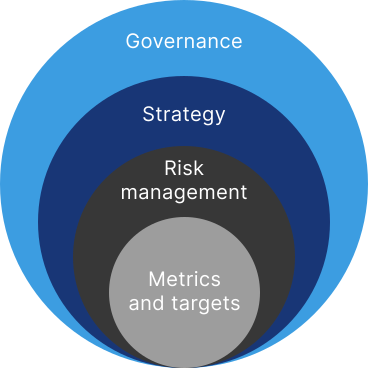
Governance
The organisation’s governance around climate-related risks and opportunities.
Strategy
The actual impacts of climate-related risks and opportunities on the organisation’s businesses, strategy and financial planning.
Risk Management
The processes used by the organisation to identify, assess and mange climate-related-risks.
Metrics and Targets
The metrics and targets used to assess and manage relevant climate-related risks and oppurtunities.
TCFD was established in 2015 to improve and increase reporting of climate related financial information and provides information to investors about the actions companies are taking to mitigate the risks of climate change, as well as providing increased clarity on the way in which they are governed.
CAML has adopted the TCFD framework and recommendations as a guide for our efforts to understand how climate change could impact a broad range of our business drivers. This provides a structured approach for the company, to work towards embedding climate into decision making, and also enabling us to learn from and apply best practice on reporting and disclosures. During 2023, we also became an official TCFD ‘supporter’.
UN SDG
By producing the metals which play a key role in transmitting renewable power, and therefore contribute positively to the energy transition, we aim to play our part to global decarbonisation. Improving energy efficiency is a key focus of the Company.

We recognise our responsibility, as a contributor of greenhouse gas emissions, to identify and implement programmes to minimise energy usage and increase use of renewable energy where possible, as well as to mitigate and adapt to the impacts of climate change throughout the value chain.
CASE STUDY
Minimising Coal Consumption at Kounrad

At Kounrad, our Scope 1 emissions predominantly reflect an essential part of our processing, which requires the heating of leaching and copper-bearing solutions in winter with coal-fired boilers to prevent freezing.
As part of our strategy to reduce emissions wherever possible across the business, this has been an area of focus for CAML.
Alternative Fuel Sources
The only option that would generate a significant reduction in GHG emissions is natural gas, which is significantly more expensive from an operating costs perspective, and capital cost requirements to install pipelines would certainly be prohibitive. This has meant that we have instead focused on achieving energy efficiencies as a way of reducing emissions.
During December 2021, Kounrad installed temperature sensors on the dripper lines on the winter blocks at the Western Dumps. The sensors allow the site team to monitor the temperature of the leachate solution at the end of the dripper lines and fuel the boilers accordingly, to ensure the solution is kept at the optimum temperature and not heated unnecessarily. The results from the 2021-2022 winter period were positive and showed a decrease in coal consumption of 15% compared to 2021, which is attributed to the newly installed temperature sensors and a milder winter. During December 2022, Kounrad installed additional sensors on the Western Dumps.
Throughout 2021 and 2022, Kounrad undertook an assessment to evaluate the possibility of using an alternative fuel source to coal to heat the leaching solution. the following alternative fuel sources were considered: wood pellets, electrical power, natural gas, diesel fuel, fuel oil and a solar water heating system. The assessment analysed the amount of Co2 (t) produced by each fuel source, the installed heating capacity and the financial costs and project economics involved.
Improving Efficiency
The assessment showed only marginal annual decreases in Co2 for five of the six alternative fuel sources compared to coal, with electrical power emitting 107% more, due to the fact that grid power locally is generated from coal-fired power stations.