



This website uses cookies so that we can provide you with the best user experience possible. Cookie information is stored in your browser and performs functions such as recognising you when you return to our website and helping our team to understand which sections of the website you find most interesting and useful.
Kounrad, Kazakhstan
Low-cost, highly profitable copper production from our operation in Kazakhstan
We are the sole owner and operator of the solvent extraction–electrowinning (SX-EW) copper recovery plant at Kounrad, near the city of Balkhash in central Kazakhstan.
This facility recovers copper from waste dumps (Eastern and Western dumps) that originated from the Kounrad open-pit copper mine. Sitting on the surface, these dumps accumulated from open-pit mining operations carried out between 1936 and 2005. Over time, oxides and low-grade sulphides of copper formed a significant tonnage deposited at the mine site.
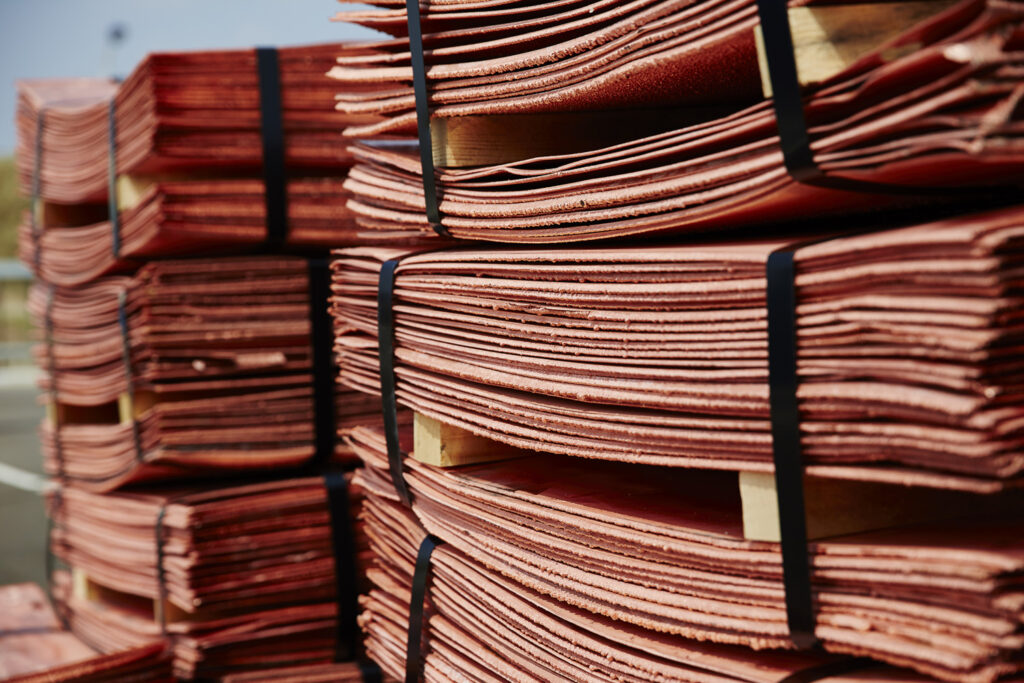
The SX-EW processing plant produces copper cathode, and the metal is delivered from the Kounrad site to the end customers, predominantly in Turkey.
CAML acquired an interest in the Kounrad project in 2007. The original agreement was a 60/40 joint venture and, in May 2014, the Company completed the acquisition of the remaining 40% of the project.
Having raised $60 million at IPO in September 2010, CAML completed construction of the Kounrad SX-EW copper plant in 2012, on schedule and US$9m below budget. The plant began producing copper in late April 2012.
Since operations on the Eastern Dumps commenced, CAML increased its annual production each year until 2016, began leaching the Western Dumps in 2017 and has now produced over 150,000 tonnes of copper cathode. Kounrad’s production has consistently been in the lowest quartile of the global copper cash cost curve.
150000
Tonnes of copper cathode recovered since 2012
Total Production
In 2015, CAML completed the Kounrad Stage 1 Expansion, on schedule and under budget, which involved increasing the PLS handling facilities and copper plating capacity.
The Stage 2 Expansion project into the Western Dumps was completed in 2017 when first copper was produced from these dumps. Both expansion projects were funded internally from cash generated from Kounrad.
10
years estimated life of operation
| Year | 2013 | 2014 | 2015 | 2016 | 2017 | 2018 | 2019 | 2020 | 2021 | 2022 | 2023 |
|---|---|---|---|---|---|---|---|---|---|---|---|
| Copper production (tonnes) | 10509 | 11136 | 12071 | 14020 | 14103 | 14049 | 13771 | 13855 | 14041 | 14254 | 13816 |
Kounrad Overview
With an overall JORC resource of c.600,000 tonnes of contained copper and c.98,000 tonnes of remaining recoverable copper, Kounrad is well placed to continue producing copper until 2034.
13816
Tonnes of copper produced to 31 December 2023
Kounrad JORC (2012) Mineral Resource Estimate, June 2017
| Mineral Resource category | Tonnes (kt) | Grade (%) | Contained metal |
|---|---|---|---|
| Indicated | 388,977 | 0.10 | 372,546 |
| Inferred | 264,023 | 0.09 | 237,175 |
| Total | 653,000 | 0.09 | 609,722 |
Note 1: WAI prepared a Mineral Resource Estimate in accordance with the JORC Code (2004) in 2013. Subsequently the JORC Code has been updated to the JORC Code (2012) which took full effect as of 01 December 2013, and the Mineral Resources reported in the 2017 CPR have therefore been amended to meet the guidelines of the JORC Code (2012).
Note 2: Copper has been produced from Kounrad since the above resources were initially estimated.
Note 3: This resource table does not include expected copper recovery. Copper recovery is estimated to be lower than a traditional copper mine, with average recovery expected from the Eastern Dumps of 45-50% and of 35-42% from the Western Dumps.
$
0.58
/lb
Average C1 cash cost since production commenced
How we produce copper
Kounrad produces copper by leaching the metal from waste dumps that were formed from years of historic mining. This process is far less cost intensive than traditional mining, as there is no need to drill, blast or transport ore – the waste dump rocks can be leached in-situ. This allows Kounrad to produce copper cheaply and efficiently.
The process used to produce copper is called Solvent Extraction and Electrowinning (SX-EW). SX-EW is a two-stage hydrometallurgical process that first extracts and upgrades acid-soluble copper from low-grade waste dumps, using dilute sulphuric acid, followed by extraction and upgrading of the leached copper solutions into an organic solvent mix containing a chemical that selectively reacts with and removes the copper. The copper is then extracted from the organic solvent using a strong solution of acid which is then plated as very high purity copper onto stainless steel cathode blanks using an electrolytic procedure (electrowinning).
Stage 1 – Leaching
At the Kounrad SX-EW project, the process consists of delivering the weak acid solution to the top of the waste dumps and irrigating the surface of the dump, through a pump and pipeline system.
The solution is distributed evenly and at a controlled rate via an extensive network of dripper pipes, which are similar to those used by gardeners for watering flower beds.
The extensive (over 7,300km) network of drippers is mobile and can be relocated to a new area (leach pad) once the previous area has been leached out, which normally takes six to twelve months.
Copper contained in the rock is dissolved by the acidic solution that slowly drains through the dump until it reaches the natural ground level, and then flows out from under the dump, following the natural bedrock gradient, into a thick-plastic lined collector trench which runs along the edge of the dump.
Stage 2 – Pumping Solution
From the collector trench the solution (now called pregnant leach solution or ‘PLS’) is pumped into storage ponds within the plant’s perimeter. These ponds not act only as a large buffer store but also assist with settling out any fine clay or rock particles, which can upset the SX process if not removed.
Stage 3 – Solvent Extraction
From the ponds, the copper-bearing PLS is pumped through the SX stage of the process. The equipment in this section looks like six large swimming pools and in these the PLS is intensively mixed with the organic reagents, and then allowed to flow and split into a copper-rich organic phase and a low-grade acidic aqueous phase. The aqueous solution is then recycled back to the dumps to dissolve more copper, whilst the organic reagent is treated further to increase the copper content in a high-strength acid solution.
Stage 4 – Electrowinning and Copper Cathode Production
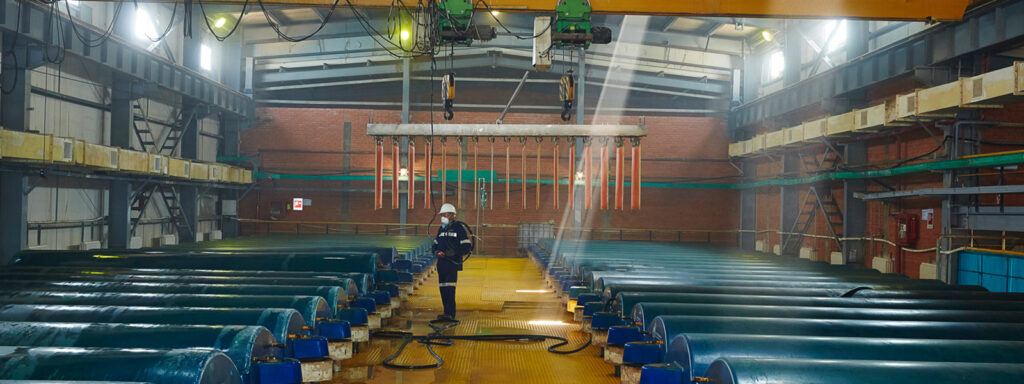
This rich copper solution, known as rich electrolyte, is then pumped to the nearby EW building where it is plated by electrolysis in 74 cells that are similar in look to a large car battery. Placed inside these cells are 2,550 lead anode plates and 2,500 stainless steel cathode sheets.
As the electric current runs through the electrolyte the copper molecules attach themselves to the cathodes and sheets of at least 99.99%-purity copper are formed. Every three days on a planned schedule a third of the stainless-steel cathodes are lifted from the cells and the copper is removed (stripped) from them. Once the copper is removed the cathodes are returned to the cells and the cycle is repeated.
The leaching, SX and EW processes run simultaneously and continuously for 24 hours a day, 7 days a week, and the copper plates that are harvested each day are stored in a secure area, prior to being shipped to the end customer – normally once or twice per month.
